
Why Can I Hear People But Not Understand What They Are Saying?
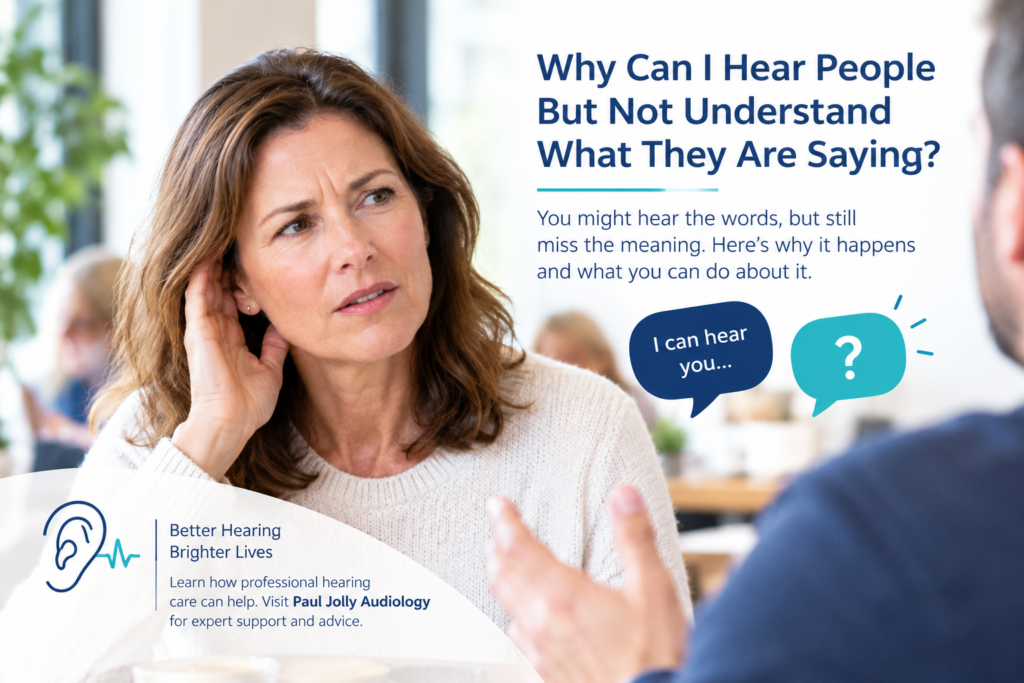
Have you ever found yourself thinking, “I can hear people talking, but I just cannot understand what they are saying”?
You can hear someone’s voice. You know they are speaking to you. You may even be able to tell roughly what they are talking about. Yet the actual words seem unclear, muffled or difficult to separate from the surrounding sounds.
This can be particularly noticeable in busy restaurants, shops, family gatherings, meetings or other places where several people are talking at the same time.
The problem may be especially frustrating because you might feel as though your hearing is normal. You can hear the television, a door closing, traffic outside or someone calling your name. But when somebody speaks to you, you may regularly ask them to repeat themselves.
This experience is often described as being able to hear but not understand speech.
There are several possible reasons for this. Hearing loss is one possibility, but it is not the only explanation. Earwax build-up, changes in the way the ear processes sound, difficulty hearing high-frequency sounds, background noise, auditory processing difficulties and other hearing-related issues can all affect how clearly speech is understood.
If you regularly experience difficulty understanding conversations, especially if other people seem to mumble or if conversations become much harder to follow in noisy places, a professional hearing assessment can help identify what may be happening.
What Does “Can Hear But Can’t Understand Speech” Actually Mean?
Hearing and understanding speech are closely connected, but they are not exactly the same thing.
Hearing involves detecting sound. Understanding speech involves being able to distinguish the different sounds that make up words, separate speech from background noise and interpret those sounds as meaningful language.
For example, you might clearly hear that someone is speaking but struggle to distinguish between words that contain softer or higher-frequency speech sounds.
This can make conversation feel like someone is speaking clearly enough for you to know that they are talking, but not clearly enough for you to understand every word.
People sometimes describe the experience as:
- “Everyone sounds like they are mumbling.”
- “I can hear their voice but not their words.”
- “I can hear people better when they face me.”
- “I understand people at home but struggle in restaurants.”
- “I keep asking people to repeat themselves.”
- “I can hear someone speaking from across the room but cannot understand the conversation.”
- “I hear better when there is no background noise.”
- “I can hear the television but struggle to follow dialogue.”
- “I can hear someone but I keep getting the words wrong.”
- “I know they are talking, but the speech isn’t clear.”
These experiences can be signs that it is worth having your hearing checked.
The NHS lists difficulty hearing other people clearly and misunderstanding what they say, particularly in noisy places, among common signs of hearing loss. Other signs include asking people to repeat themselves, struggling to keep up with conversations and finding it difficult to hear on the telephone.
Why Can I Hear People But Not Understand What They Are Saying?
There is no single explanation for this symptom.
One of the most common possibilities is hearing loss, particularly hearing loss that affects the frequencies important for speech clarity.
However, there are several other factors that can contribute.
1. Hearing Loss Can Affect Speech Clarity
Hearing loss does not necessarily mean that sounds disappear completely.
In many cases, sounds remain audible but become less clear.
This is one reason someone can hear that another person is speaking without being able to understand exactly what they are saying.
Some types of hearing loss affect particular frequencies more than others. When important speech sounds become harder to detect, words can become more difficult to distinguish.
A person might therefore say:
“I can hear them, but they sound like they are mumbling.”
This does not necessarily mean the other person is actually mumbling.
The problem may be that some of the speech information is no longer reaching the listener clearly enough.
NHS audiology information notes that mild hearing loss can cause people to hear speech without being able to make out what is being said, and that the problem can become more noticeable in noisy environments.
2. Background Noise Can Make Speech Much Harder to Understand
One of the biggest challenges for people with hearing difficulties is background noise.
Imagine sitting in a quiet room with one person speaking directly to you.
You may understand almost everything they say.
Now imagine the same conversation taking place in a busy restaurant.
There may be:
- Other conversations
- Music
- Plates and cutlery
- Kitchen noise
- Chairs moving
- People walking around
- Traffic outside
Suddenly, the conversation becomes much more difficult.
The person’s voice may still be audible, but separating it from everything else becomes harder.
Difficulty understanding speech in background noise is a common complaint associated with hearing loss. Audiology professionals can also use speech-in-noise testing to investigate how well someone understands speech when competing sounds are present.
This is why someone may say:
“My hearing is fine at home, but I cannot understand anyone in a restaurant.”
That difference is important.
Why Is It Easier to Understand Someone in a Quiet Room?
In a quiet environment, there is less competing sound.
Your brain can focus more easily on the person’s voice.
When background noise increases, the brain has to separate the target speech from competing sounds.
If some speech sounds are already difficult to hear because of hearing loss or another hearing difficulty, background noise can make the problem much more obvious.
This is why a person might manage a one-to-one conversation at home but struggle during:
- Family dinners
- Weddings
- Parties
- Restaurants
- Meetings
- Shopping centres
- Busy cafés
- Public events
- Group conversations
A hearing assessment can help determine whether hearing sensitivity is contributing to the problem.
3. High-Frequency Hearing Loss Can Affect Understanding
Speech contains a wide range of frequencies.
Some of the higher-frequency sounds in speech are important for distinguishing between words.
If these sounds become harder to hear, speech may still sound loud enough but lose some of its clarity.
For example, you may hear the general shape and rhythm of a sentence but have difficulty identifying particular consonants.
This can make similar-sounding words difficult to distinguish.
A person may therefore hear:
“I know they said something, but I couldn’t quite make out the word.”
This is one reason hearing tests look at hearing sensitivity across different frequencies rather than simply asking whether someone can hear sound.
4. Earwax Can Make Speech Sound Muffled
Earwax is another possible contributor.
A significant build-up of earwax can block the ear canal and cause hearing difficulties. The NHS lists impacted earwax among causes of conductive hearing loss.
When the ear canal is blocked, sounds may become quieter or muffled.
You might notice:
- Muffled hearing
- A blocked sensation
- Difficulty hearing speech clearly
- Hearing that seems worse in one ear
- Ringing or other unusual ear sounds
- A feeling of fullness in the ear
If you think earwax may be contributing to your hearing difficulty, it is important not to insert cotton buds or other objects into the ear.
Trying to remove earwax yourself can push wax further into the ear canal or cause injury.
A professional can assess the ear and determine whether wax needs to be removed.
5. One Ear May Be Hearing Differently From the Other
Sometimes the problem is more noticeable because one ear is hearing differently from the other.
You may not immediately realise that this is happening.
Instead, you might simply notice that:
“I understand people better when they are standing on my right side.”
Or:
“I struggle when someone talks to me from my left.”
Differences between the two ears can affect how easily you locate sounds and follow conversations, particularly when there is background noise.
If you notice a significant difference between your ears, a hearing assessment is worth considering.
6. Hearing Loss Can Make People Sound Like They Are Mumbling
One of the classic descriptions of hearing difficulty is that everyone seems to mumble.
This can be confusing because the people around you may insist they are speaking normally.
The problem may not be the volume of the person’s voice.
It may be the clarity of the speech reaching your ears.
If certain speech sounds are less audible, words can lose their definition.
This can make several different people seem as though they are speaking unclearly.
If multiple people sound as though they are mumbling, particularly when you are in a group or noisy environment, it may be worth getting your hearing checked rather than assuming everyone needs to speak louder.
7. You May Have Difficulty Hearing Speech in Groups
Following one person in a quiet room is very different from following a conversation involving five or six people.
In a group:
- Speakers change constantly.
- Voices overlap.
- People may speak from different directions.
- Background noise can interfere.
- Conversations may move quickly.
- You may not always be able to see the person speaking.
This can make it harder to keep up.
You may find yourself watching people’s faces to work out what they are saying or waiting for other people to laugh before realising that you missed the joke.
You might also find yourself concentrating extremely hard throughout the conversation.
Listening fatigue can be a sign that your hearing is requiring more effort than it used to.
8. Auditory Processing Difficulties Can Affect Speech Understanding
Not every person who struggles to understand speech has hearing loss.
Some people have difficulty processing and making sense of sounds even when their basic hearing tests are relatively normal.
Auditory processing disorder, or APD, is a condition involving difficulty understanding sounds, including spoken words. People with APD may have particular difficulty understanding speech in noisy places, following fast speakers or understanding similar-sounding words.
Importantly, struggling with speech does not automatically mean you have APD.
There are many possible explanations for difficulty understanding speech, and similar symptoms can occur in people without APD.
This is why a proper assessment is more useful than trying to diagnose yourself based on one symptom.
Can You Have Normal Hearing But Still Struggle With Speech?
Yes.
Some people report significant difficulty understanding speech, particularly in background noise, despite having a normal or near-normal audiogram.
Research has specifically examined people who experience difficulties understanding speech in noise even when conventional hearing tests show normal or near-normal hearing.
This is one reason it is important to describe your real-world listening difficulties during a hearing assessment.
Do not simply tell the audiologist:
“My hearing is fine.”
Instead, explain what happens in everyday situations.
For example:
“I can hear one person in a quiet room, but I cannot follow conversations in restaurants.”
That information can be extremely useful.
Why Do Restaurants Make Hearing So Difficult?
Restaurants are one of the most challenging listening environments for many people.
They combine speech with multiple sources of competing sound.
There may also be echoes and reverberation caused by hard surfaces.
This means the sound reaching your ears may contain the speaker’s voice mixed with reflections and background noise.
RNID explains that background noise can mask speech, while reverberation can make speech less clear by causing sound to bounce around a room.
This is why someone may have very little difficulty talking to a family member at home but struggle to understand that same person across a restaurant table.
Why Can I Hear Someone But Not Understand Them on the Phone?
Telephone conversations remove some of the visual information that normally helps us understand speech.
When you are speaking face-to-face, you can often use:
- Facial expressions
- Lip movements
- Gestures
- Context
- The direction of the person’s gaze
On the phone, you mainly rely on the audio.
If speech already sounds unclear, the lack of visual information can make conversations harder.
Background noise can make the situation even more difficult.
If you frequently struggle to understand people on the phone, mention this during your hearing assessment.
Why Is Hearing Worse When People Talk Quickly?
Fast speech gives you less time to identify individual words.
This can become especially difficult if your hearing already makes certain sounds less clear.
You may understand the first few words of a sentence but lose track when the speaker speeds up.
You might also struggle when several people interrupt one another or change topics quickly.
This does not necessarily mean that you have a processing disorder.
It may simply reveal a listening situation in which your hearing difficulties become more obvious.
Why Do I Understand People Better When I Can See Their Face?
Visual information can help with communication.
Seeing the speaker’s face gives you additional context and can help you follow the conversation.
This is one reason NHS guidance recommends facing people when they are speaking and reducing background noise when possible.
If you consistently understand people much better when you can see their face, mention this to your audiologist.
Signs That You Should Have Your Hearing Checked
You may want to arrange a hearing assessment if you regularly:
- Ask people to repeat themselves.
- Mishear words.
- Feel that everyone is mumbling.
- Struggle to understand people in restaurants.
- Find group conversations difficult.
- Turn the television volume up.
- Have difficulty following conversations on the phone.
- Prefer people to face you when they speak.
- Struggle when there is background noise.
- Find yourself concentrating very hard to follow conversations.
- Avoid social situations because conversations are difficult.
- Notice that one ear seems better than the other.
- Have muffled hearing.
- Experience a blocked sensation in your ears.
- Notice ringing or other changes in your hearing.
The NHS identifies several of these symptoms as common signs of hearing loss, including misunderstanding speech, asking people to repeat themselves, difficulty following conversations and increased listening effort.
What Happens During a Hearing Test?
A hearing assessment is designed to provide information about how well you hear different sounds.
Your audiologist will normally ask questions about your hearing and the situations in which you experience difficulties.
You may be asked about:
- When you first noticed the problem
- Whether one or both ears are affected
- Whether you struggle in noisy places
- Whether you have tinnitus
- Whether you have experienced ear infections
- Whether you have had problems with earwax
- Whether hearing difficulties affect your work or social life
The assessment can then help determine whether further investigation or hearing support may be appropriate.
Can a Hearing Test Detect Why Speech Sounds Unclear?
A hearing test can provide important information about your hearing sensitivity.
Depending on your symptoms and the type of assessment available, an audiologist may also consider how you manage speech, including speech presented in background noise.
Speech-in-noise testing can provide information that conventional testing in quiet may not show. ASHA notes that speech-in-noise results can differ from results obtained in quiet environments and can provide information about hearing in more realistic listening situations.
This is particularly relevant if you repeatedly say:
“I can hear, but I can’t understand speech when there is noise.”
What If My Hearing Test Is Normal?
A normal hearing test does not mean that your concerns should automatically be ignored.
If you continue to struggle with understanding speech, particularly in noisy environments, tell your hearing professional exactly what situations cause the problem.
There can be several reasons why speech understanding is difficult even when standard hearing thresholds are within normal limits.
Depending on your circumstances, your clinician may consider whether further assessment is appropriate.
The important point is that your everyday experience matters.
A hearing assessment should not simply be about whether you can detect a beep in a quiet testing room.
Your ability to communicate in real-world situations is also important.
How Can I Make Conversations Easier?
There are several practical strategies that can make conversations easier.
Move Somewhere Quieter
If possible, reduce competing noise.
Moving away from loud music, busy kitchens or multiple conversations can make speech easier to follow.
Face the Speaker
Try to position yourself so that you can clearly see the person speaking.
This can provide useful visual information and makes communication easier.
Ask People to Speak Clearly
You do not necessarily need people to shout.
In fact, shouting can sometimes make speech less comfortable or clear.
Instead, ask people to speak clearly and at a natural pace.
Ask People to Rephrase
If repeating the same sentence does not help, ask the person to say it differently.
Sometimes a different choice of words makes the meaning much easier to understand.
RNID recommends asking someone to repeat or say something differently when you have not understood them.
Reduce Distance
If someone is speaking from far away, moving closer can make it easier to hear.
Reduce Multiple Conversations
In a group, try to position yourself where you can see the people who are most likely to speak.
Reducing competing conversations can also help.
Tell People What Helps
There is nothing wrong with saying:
“I hear you better if you face me.”
or:
“Could we move somewhere quieter?”
Making small changes can make conversations much less tiring.
Could Hearing Aids Help If I Can Hear But Cannot Understand Speech?
If hearing loss is contributing to your difficulty understanding speech, hearing aids may be one option an audiologist discusses with you.
Modern hearing aids are designed to do more than simply make every sound louder.
Depending on the device and individual circumstances, hearing technology can be used to support communication in different listening environments.
However, hearing aids are not a guarantee that every conversation will suddenly become effortless.
Background noise, room acoustics, the severity and type of hearing loss and other factors can all affect speech understanding.
The aim is to find an appropriate solution based on your individual hearing needs.
What If I Only Struggle in Noisy Places?
This is a very common situation.
You may have little trouble talking to someone in a quiet room but struggle in:
- Restaurants
- Pubs
- Cafés
- Parties
- Weddings
- Busy offices
- Family gatherings
- Shops
- Public transport
- Large meetings
Do not dismiss the problem simply because you can hear well in quiet.
Difficulty understanding speech in background noise is an important part of many people’s real-world hearing experience.
A hearing assessment can help you understand whether hearing loss or another factor may be contributing.
Why Do I Feel Tired After Conversations?
Listening can require considerably more concentration when speech is difficult to understand.
If you constantly have to fill in missing words, concentrate on someone’s face, ignore background noise and guess what has been said, conversations can become mentally tiring.
The NHS lists feeling tired or stressed from having to concentrate while listening as one possible sign associated with hearing loss.
You might notice this particularly after:
- Long meetings
- Family events
- Social gatherings
- Restaurant meals
- Telephone conversations
- Busy working days
If communication has become exhausting, it is worth mentioning this when you have your hearing checked.
Can Hearing Loss Affect Social Life?
It can.
When conversations become difficult, people may start avoiding situations where they expect to struggle.
Someone might stop attending restaurants because they cannot follow conversations.
They may become quieter in group discussions because they are worried about answering the wrong question.
They may avoid asking people to repeat themselves because they feel embarrassed.
Over time, this can make hearing difficulties about much more than simply hearing sounds.
Getting your hearing checked can be an important first step toward understanding what is happening and exploring appropriate support.
What Should I Do If I Can Hear But Can’t Understand Speech?
Start by paying attention to when the problem occurs.
Ask yourself:
Can I understand people in quiet rooms?
Is speech harder to understand in noisy places?
Do people sound as though they are mumbling?
Do I often ask people to repeat themselves?
Is one ear noticeably better than the other?
Do I struggle on the telephone?
Do I turn the television up?
Do I find group conversations particularly difficult?
Do I experience tinnitus, blocked ears or muffled hearing?
Do conversations leave me unusually tired?
Your answers can help an audiologist understand what you are experiencing.
When Should You Arrange a Hearing Assessment?
If difficulty understanding speech is becoming a regular part of your life, it is worth having your hearing assessed.
You do not need to wait until you are unable to hear sounds at all.
Hearing difficulties can develop gradually, and many people adapt to them without realising how much their hearing has changed.
You might initially compensate by:
- Turning up the television
- Asking people to repeat themselves
- Sitting closer to people
- Watching people’s faces
- Avoiding noisy restaurants
- Choosing quieter seats
- Asking family members to speak louder
These adaptations can become so normal that you may not immediately recognise them as signs of a hearing problem.
Professional Hearing Care in Ruislip
If you are based in Ruislip or the surrounding area and have noticed that you can hear people speaking but increasingly struggle to understand their words, a professional hearing assessment can help you investigate the cause.
An audiologist can assess your hearing and discuss the situations in which you experience the greatest difficulty.
If you also have earwax build-up, blocked ears or muffled hearing, this may need to be considered as part of your overall hearing care.
For professional hearing care, hearing assessments and advice about hearing difficulties, you can learn more about Paul Jolly Audiology.
The important thing is not to assume that the problem is simply that everyone around you is mumbling.
If speech has become harder to understand, your hearing may be telling you that it is time for a closer look.
Can You Hear But Not Understand Speech? Don’t Ignore the Difference
Being able to hear sound does not necessarily mean that you are hearing speech clearly.
You may hear someone’s voice but struggle to identify individual words. You may understand them perfectly in a quiet room but lose track of the conversation in a restaurant. You may hear the television but struggle to understand dialogue. Or you may find yourself repeatedly asking friends and family to repeat themselves.
These experiences can have several possible causes, including hearing loss, earwax, difficulty hearing particular speech frequencies, background noise and auditory processing difficulties.
The good news is that you do not have to simply put up with the problem.
A professional hearing assessment can help establish how well you are hearing and provide a clearer understanding of why speech may be difficult to follow.
If you keep finding yourself thinking, “I can hear people, but I can’t understand what they’re saying,” consider arranging a hearing assessment and discussing your symptoms with a qualified hearing professional.
Frequently Asked Questions
Why can I hear but not understand speech?
You may be able to detect sounds normally while still having difficulty distinguishing the speech sounds that make words clear. Hearing loss, particularly certain types of high-frequency hearing loss, can make speech sound muffled or unclear. Background noise can make the problem more noticeable.
Why can I hear people talking but not understand their words?
This can happen when some of the sounds that provide speech clarity are difficult to hear or distinguish. It can also happen when background noise competes with the speaker’s voice. If this happens regularly, a hearing assessment can help investigate the cause.
Why does everyone sound like they are mumbling?
If speech sounds muffled or unclear, people may seem as though they are mumbling even when they are speaking normally. Changes in hearing can reduce the clarity of speech, making certain words and consonants harder to distinguish.
Why can I understand people at home but not in restaurants?
Restaurants contain multiple competing sounds, including conversations, music, kitchen noise and echoes. Background noise can mask speech and make it harder to separate one person’s voice from everything else. Hearing difficulties may therefore become much more noticeable in these environments.
Can earwax cause difficulty understanding speech?
Yes. A significant build-up of earwax can block the ear canal and contribute to muffled hearing. If you suspect earwax is affecting your hearing, avoid putting cotton buds or other objects into your ears and consider having your ears assessed professionally.
Can you have normal hearing and still struggle to understand speech?
Yes. Some people experience difficulty understanding speech, particularly in noisy environments, even when their conventional hearing test shows normal or near-normal hearing. This is one reason it is important to explain your real-world listening difficulties to an audiologist.
Can hearing aids help me understand speech?
If hearing loss is contributing to your difficulty understanding speech, hearing aids may be appropriate. An audiologist can assess your hearing and discuss whether hearing technology could help in the situations where you struggle most.
Why is understanding speech so difficult in groups?
Group conversations involve multiple speakers, overlapping voices and changing directions of sound. Background noise can make this even harder. If hearing loss is present, following a group conversation may require significantly more listening effort.
Should I have a hearing test if I can still hear sounds?
Yes, if you are regularly struggling to understand conversations. Hearing difficulties do not necessarily mean that sounds have disappeared completely. You can still hear many sounds while having difficulty understanding speech clearly.
What should I tell my audiologist?
Explain exactly when you struggle. Tell them whether the problem happens in quiet rooms, restaurants, groups, on the telephone or while watching television. Also mention any muffled hearing, blocked ears, tinnitus, earwax problems or differences between your ears.
Is difficulty understanding speech always caused by hearing loss?
No. Hearing loss is one possible cause, but not the only one. Earwax, background noise, listening conditions and auditory processing difficulties can also affect speech understanding. A professional assessment can help determine what may be contributing to your symptoms.
Why do I understand people better when they face me?
Seeing someone’s face provides additional visual information that can support communication. Facing the speaker can also make it easier to identify where the voice is coming from. NHS guidance recommends facing people when they speak and reducing background noise when possible.
Why do conversations make me so tired?
If you have difficulty hearing speech clearly, you may need to concentrate more intensely, use context to fill in missing information and continually work out what people are saying. This additional listening effort can make conversations tiring.
Can a hearing test check how well I understand speech in noise?
Depending on the assessment, an audiologist may use speech testing or speech-in-noise testing to investigate how you manage speech when competing sounds are present. Speech-in-noise testing can provide information that may not be captured by hearing tests performed only in quiet.
What is the first step if I can hear but cannot understand people?
The first practical step is to arrange a hearing assessment, particularly if the problem is persistent or affecting everyday communication. Tell the hearing professional exactly which situations cause difficulty rather than simply saying that your hearing is “fine.”