
Ear Wax Removal Before a Hearing Test: Is It Necessary?
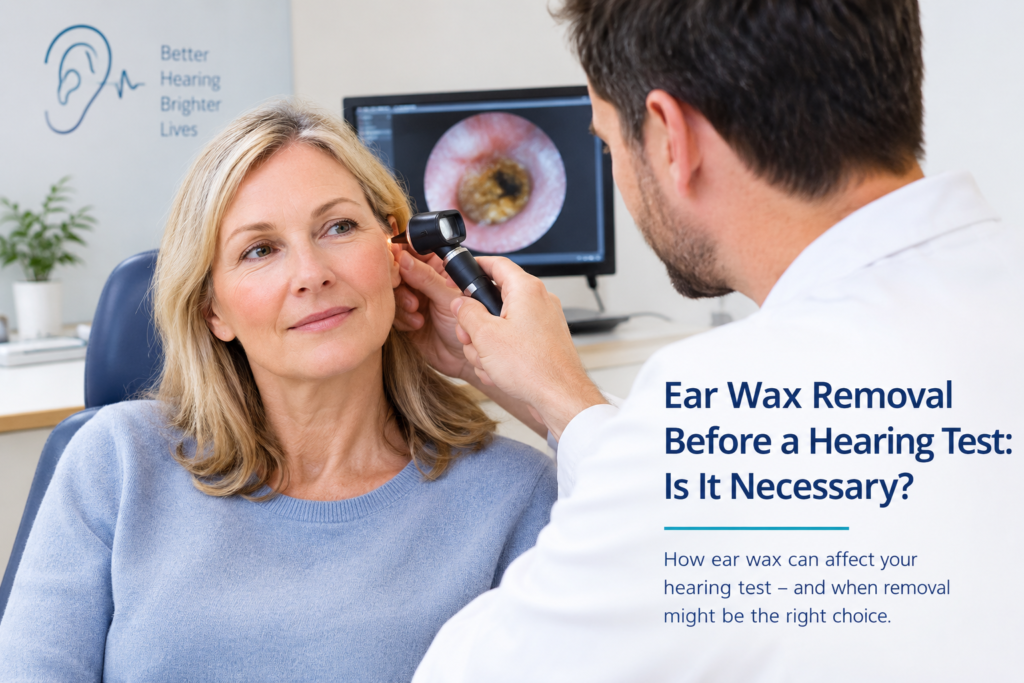
If you have booked a hearing test and also suspect that you have a build-up of ear wax, you may be wondering whether you should have your ears cleaned before your appointment.
The answer depends on the amount of ear wax present, where it is located and whether it is affecting the ear canal or your hearing.
Ear wax is a natural substance that protects the ear canal, but excessive or impacted ear wax can sometimes block sound from reaching the eardrum properly. This can result in symptoms such as muffled hearing, a feeling of fullness, reduced hearing in one ear or both ears, and sometimes discomfort.
Because hearing tests are designed to assess how well you can hear different sounds, significant ear wax blockage can sometimes affect the results. For this reason, an ear examination may be an important part of the process before a hearing assessment.
In some cases, removing excessive ear wax before a hearing test can make it easier for an audiologist to examine the ear and obtain a clearer picture of your hearing.
What Is Ear Wax?
Ear wax, medically known as cerumen, is produced naturally inside the ear canal.
Although many people think of ear wax as something that needs to be removed regularly, it actually has several useful functions. It can help protect the skin inside the ear canal and trap dust and other particles before they travel further into the ear.
The ears are generally designed to move old ear wax towards the entrance of the ear canal naturally.
Problems can occur when too much wax accumulates or when wax becomes impacted deeper inside the canal.
Some people naturally produce more ear wax than others. Ear wax can also become problematic for people who regularly use hearing aids, earphones or other devices that sit in or around the ear canal.
When wax becomes excessive, it may interfere with hearing.
Can Ear Wax Affect the Results of a Hearing Test?
Yes, significant ear wax can affect hearing.
When ear wax blocks part of the ear canal, it can reduce the amount of sound reaching the eardrum. This type of hearing difficulty is different from hearing loss caused by problems involving the inner ear or auditory nerve.
This is one reason why an audiologist may look inside the ears before carrying out a hearing assessment.
If there is substantial wax blocking the ear canal, the hearing test may not provide the clearest representation of your hearing ability.
This does not mean that everyone needs ear wax removal before having a hearing test.
A small amount of ear wax is usually not automatically a reason to postpone an appointment. The important question is whether the wax is significant enough to interfere with the examination or hearing assessment.
Should You Remove Ear Wax Before a Hearing Test?
If you know that you have a significant build-up of ear wax, it may be worth having your ears assessed before your hearing test.
However, you should not automatically try to remove the wax yourself.
The safest approach is to have your ears examined by an appropriate healthcare professional or ear care provider who can determine whether removal is necessary.
If the ear canal is clear enough for the hearing assessment, you may not need ear wax removal at all.
If the canal is significantly blocked, professional ear wax removal may be recommended before or alongside further hearing assessment.
This is particularly relevant if you have noticed a recent change in your hearing and are unsure whether the change is caused by ear wax or another hearing-related issue.
Why an Ear Examination May Be Part of a Hearing Assessment
A hearing test is not simply about putting on headphones and listening for beeps.
A hearing professional may first ask questions about your hearing, medical history and symptoms. Depending on the assessment, they may also examine the ears and ear canals.
Looking inside the ear can provide useful information about whether there is an obvious blockage or another issue that could affect the assessment.
For example, if one ear contains a large amount of wax while the other ear is relatively clear, the difference in hearing may potentially be influenced by the blockage.
This is why identifying and addressing ear canal blockage can be an important part of understanding someone’s hearing.
What Happens If You Have Ear Wax on the Day of Your Hearing Test?
If you arrive for a hearing test and the audiologist notices ear wax, it does not necessarily mean that your appointment will be cancelled.
The appropriate next step depends on the amount of wax and the type of assessment being carried out.
In some situations, the hearing professional may be able to continue with the assessment.
In other situations, they may recommend having the wax removed first and returning for another hearing assessment afterwards.
The decision can depend on whether the wax is obstructing the ear canal and whether it is likely to influence the accuracy or interpretation of the hearing assessment.
If you are concerned about ear wax before your appointment, it can be useful to mention this when booking.
Can Ear Wax Cause Temporary Hearing Loss?
Excessive ear wax can sometimes cause a temporary reduction in hearing.
People may describe the sensation as:
- Muffled hearing
- Sounds seeming quieter than usual
- A blocked or plugged-up ear
- Difficulty hearing conversations
- Difficulty hearing on the telephone
- A feeling of pressure or fullness
- Hearing that seems worse in one ear
- Sounds seeming different between the two ears
The hearing change may be particularly noticeable when the ear canal becomes substantially blocked.
This is sometimes referred to as conductive hearing difficulty because the problem is related to the way sound is conducted through the outer or middle ear.
However, not every change in hearing is caused by ear wax.
That distinction is important.
If hearing remains reduced after an appropriate ear wax assessment or removal, a hearing test can help determine whether another type of hearing difficulty may be present.
Why You Shouldn’t Use Cotton Buds Before a Hearing Test
If you think your ears contain wax, you may be tempted to clean them yourself before your appointment.
Cotton buds are a common choice, but putting them into the ear canal can push wax further inside rather than removing it.
This can potentially make an existing blockage worse.
There is also a risk of irritating or damaging the delicate skin of the ear canal.
For these reasons, you should avoid putting objects deep into the ear in an attempt to remove ear wax.
The outer part of the ear can generally be cleaned gently, but deeper ear wax should be assessed appropriately rather than repeatedly pushed further into the canal.
What About Ear Drops Before a Hearing Test?
Some people use ear wax-softening drops when they know they have a build-up of wax.
Whether drops are appropriate depends on the individual and their ear health.
If you have been advised to use ear drops, follow the instructions provided by an appropriate healthcare professional or the product instructions.
However, if you have symptoms such as significant ear pain, discharge, a known or suspected perforated eardrum, previous ear surgery or other ear problems, it is important to seek appropriate medical advice rather than assuming that wax is the cause.
If you are unsure whether your symptoms are related to ear wax, an ear examination can help determine the next step.
Does Ear Wax Always Need to Be Removed?
No.
Ear wax is normal and does not automatically need to be removed simply because it is visible.
The aim of ear wax removal is not to make the ears completely free of wax.
Instead, removal may be considered when wax has become problematic.
This could include situations where wax is:
- Blocking the ear canal
- Affecting hearing
- Causing discomfort
- Contributing to a sensation of fullness
- Interfering with the examination of the ear
- Preventing an appropriate hearing assessment
If there is only a small amount of wax and it is not causing any problems, removal may not be necessary.
Ear Wax Removal and Hearing Tests: Which Comes First?
This is one of the most common questions people have.
There is no universal rule that everyone must have ear wax removed before a hearing test.
Instead, the order depends on the condition of the ears.
For example, someone with clear ear canals and no significant wax may be able to proceed directly with a hearing assessment.
Someone with substantial impacted wax may need the wax addressed before the hearing assessment can provide useful information.
Another person may have mild wax that does not interfere with the assessment at all.
This is why an individual assessment is important.
Rather than booking ear wax removal automatically, consider discussing the issue with the hearing professional or ear care provider when arranging your appointment.
Why Removing Wax Can Make a Hearing Assessment More Useful
When the ear canal is significantly blocked, it can be difficult to determine how much of the hearing difficulty is related to the blockage and how much may be related to another part of the hearing system.
Removing problematic wax can therefore help provide a clearer starting point for assessing hearing.
For someone who has noticed a recent decline in hearing, this distinction can be particularly useful.
For example, a person may assume they need hearing aids because sounds have become quieter.
However, if the main issue is a substantial ear wax blockage, treating the blockage may change the hearing experience.
On the other hand, if hearing remains reduced after the wax problem has been addressed, a hearing assessment can help investigate the hearing more thoroughly.
What If Your Hearing Is Still Poor After Ear Wax Removal?
If you have had significant ear wax removed but your hearing still seems reduced, it is worth discussing this with a hearing professional.
Ear wax is only one possible reason for reduced hearing.
Hearing can also be affected by age-related changes, long-term exposure to loud noise, certain illnesses, ear conditions and other factors.
A hearing test can help establish how well you are hearing different frequencies and whether there is a measurable hearing loss.
This is where professional audiology can become particularly useful.
If you are looking for further information about hearing assessments and audiology services in Ruislip, you can visit Paul Jolly Audiology for more information about hearing care and available services.
Should You Book a Hearing Test If You Have Blocked Ears?
Yes, if you are experiencing persistent hearing difficulties, it can be appropriate to seek professional advice even if you suspect ear wax is responsible.
The important thing is not to assume that every blocked ear is caused by wax.
A blocked sensation can have several possible causes.
If an examination confirms that ear wax is responsible, appropriate ear wax management can be considered.
If the ear canal is clear but your hearing remains reduced, further hearing assessment may be appropriate.
This is one reason why professional assessment can be more useful than trying to diagnose the problem yourself.
Can Hearing Aids Be Fitted If You Have Ear Wax?
If someone has significant ear wax, it may be sensible to address the blockage before proceeding with hearing aid assessment or fitting.
This is because hearing professionals need to understand the person’s actual hearing needs.
If hearing appears reduced because of a temporary blockage, the hearing picture may change after the wax is removed.
For someone who already wears hearing aids, recurring ear wax can also sometimes become an issue.
Hearing aid users may notice that their devices do not seem to work as expected when their ears become blocked.
This does not necessarily mean that the hearing aid itself is faulty.
An ear examination can help determine whether wax or another issue may be contributing to the change.
Can Ear Wax Affect One Ear More Than the Other?
Yes.
It is possible for one ear to have considerably more wax than the other.
This can result in someone noticing a difference in hearing between their ears.
For example, you may notice that one ear feels blocked while the other feels completely normal.
If you are preparing for a hearing test and one ear feels significantly more blocked than the other, mention this to the hearing professional.
Differences between the ears can be important when assessing hearing.
What Should You Do Before Your Hearing Test?
If you have a hearing test coming up, there is generally no need to panic about ear wax.
Instead, consider the following:
1. Don’t put cotton buds into your ears
Avoid attempting to dig wax out of the ear canal yourself.
2. Tell the clinic about your symptoms
If you have blocked ears, muffled hearing or suspected wax, mention this when booking or attending your appointment.
3. Don’t assume wax is the only cause
Hearing changes can have several possible causes.
4. Ask whether your ears need to be examined first
A professional can determine whether wax is significant enough to affect the assessment.
5. Follow professional advice about ear wax removal
If removal is recommended, follow the guidance provided rather than attempting potentially unsafe methods yourself.
6. Attend your hearing assessment if advised
If your hearing remains reduced after the ear wax issue has been addressed, a hearing assessment can provide useful information about your hearing.
What Is the Best Way to Have Ear Wax Removed?
If ear wax needs to be removed, the appropriate method depends on the individual.
Professional ear wax removal may involve methods such as microsuction, depending on the circumstances and the provider’s assessment.
Microsuction involves using controlled suction to remove ear wax under visual guidance.
It is commonly used by ear care providers and audiology clinics, but whether it is appropriate for you should be determined by a suitably qualified professional.
The important point is that ear wax removal should be approached as an ear-care procedure rather than simply trying to clean deeper inside the ear yourself.
When Should You Seek Medical Advice?
Most ear wax problems are straightforward, but not every ear symptom should automatically be attributed to wax.
Seek appropriate medical advice if you experience concerning symptoms such as significant or persistent ear pain, discharge, sudden hearing changes, severe dizziness or other symptoms that do not seem consistent with ordinary ear wax build-up.
A professional assessment can help establish whether wax is actually responsible for your symptoms.
This is particularly important when hearing changes suddenly or significantly.
Ear Wax Removal Before a Hearing Test: The Bottom Line
So, is ear wax removal before a hearing test necessary?
Not always.
If your ears contain only a small amount of wax and the ear canal is sufficiently clear, you may be able to proceed with your hearing assessment without having the wax removed.
If there is substantial or impacted wax blocking the ear canal, however, removal may be recommended before a hearing assessment or before certain parts of the assessment can be completed.
The most important thing is to avoid assuming that all hearing problems are caused by ear wax.
Ear wax can cause temporary hearing difficulties when it significantly blocks the ear canal, but persistent hearing loss may have another cause.
If you are concerned about your hearing, an assessment can help establish what is happening and whether further hearing care is appropriate.
For more information about hearing assessments, audiology and hearing care in Ruislip, visit Paul Jolly Audiology.
Whether you have noticed muffled hearing, difficulty following conversations, ringing in your ears or simply feel that your hearing has changed, getting the right assessment can help you understand what may be contributing to the problem.
Frequently Asked Questions
Do I need ear wax removal before a hearing test?
Not necessarily. Ear wax does not always need to be removed before a hearing test. If the ear canal is sufficiently clear, the hearing assessment may be able to go ahead. If there is substantial wax blocking the canal, removal may be recommended first.
Can ear wax make a hearing test inaccurate?
Significant ear wax can affect the way sound travels through the ear canal and may therefore affect hearing measurements. An ear examination can help determine whether wax is likely to interfere with the assessment.
Should I clean my ears before a hearing test?
You should avoid putting cotton buds or other objects deep into your ears. If you suspect a significant wax build-up, speak to an appropriate ear care or hearing professional rather than trying to remove it yourself.
Can ear wax cause temporary hearing loss?
A substantial build-up of ear wax can reduce hearing by blocking the ear canal. Hearing may improve once the blockage has been appropriately addressed, although persistent hearing loss should be assessed rather than automatically attributed to wax.
Can I have a hearing test if my ear is blocked?
It depends on the cause and severity of the blockage. If ear wax significantly obstructs the ear canal, the hearing professional may recommend addressing the wax before completing or interpreting the hearing assessment.
How do I know whether my blocked ear is caused by wax?
Symptoms such as muffled hearing, fullness or a blocked sensation can occur with ear wax, but these symptoms can also have other causes. An examination of the ear can help determine whether wax is present and whether it is likely to be responsible.
Should I use ear drops before a hearing test?
Only use ear drops according to appropriate professional or product guidance. If you have existing ear problems, ear pain, discharge, previous ear surgery or a suspected perforated eardrum, seek appropriate medical advice before treating the ear as a simple wax problem.
Can ear wax affect only one ear?
Yes. One ear can contain more wax than the other, potentially resulting in different hearing between the ears. If you notice a significant difference, mention it during your hearing assessment.
What happens if my hearing is still poor after ear wax removal?
If hearing remains reduced after problematic wax has been addressed, a hearing assessment can help determine whether another form of hearing difficulty may be present. This is one reason why professional hearing assessment can be useful after treating an obvious ear blockage.
Where can I get a hearing assessment in Ruislip?
If you are looking for audiology and hearing-care information in Ruislip, you can learn more about services available through Paul Jolly Audiology.